Genealogy and history conferences: Advantageous to your social history research

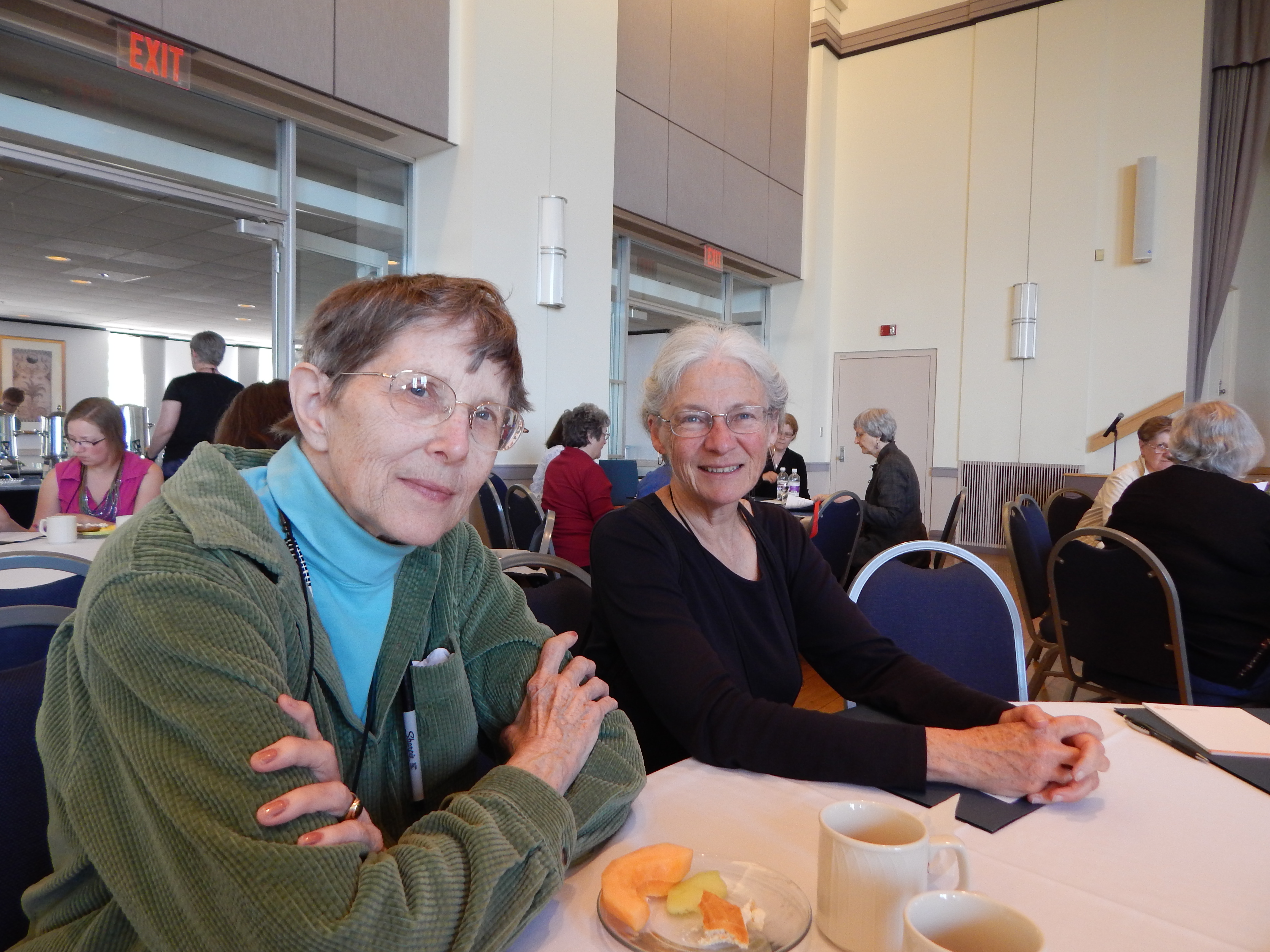
On Monday I went to the annual Mass History Conference. The theme was “Never Done!: Interpreting the History of Women at Work in Massachusetts”. The theme intrigued me, but I mostly went for the networking. The conference was held at Holy Cross College in Worcester. It is beautiful.

DSCN1444

I have picked up so many wonderful tidbits from networking at various genealogy and history events, as well as from groups and friends on Facebook and Twitter. This conference was no different.

I sat next to 2 city archivists from Gloucester and told them about my thesis research. They
gave me some wonderful ideas for future research after I have completed my thesis.

DSCN1435

Laurel Thatcher Ulrich was the keynote speaker and mentioned that Harvard had just released a free online EdX course about material culture. I signed up and am auditing it.

DSCN1437

Quite a few people came-we filled the ballroom at Holy Cross College in Worcester.

DSCN1441

The best part for me though was what came after a panel discussion on archival resources for women’s research. One of the panelists was from the National Archives. She brought some really fun things, including pictures of women lumberjacks in the 1930s and government records for the Von Trapp family (Sound of Music). I mentioned the Indian depredations records I had found in the US Serial Set for Levi Savage and she gave me the email address for another NARA employee who knows everything about Congressional records and government records related to Indians. She is not in the Boston or DC office, so I may never have found her if I hadn’t been networking. I am pulling together everything and will then email her.

One of the afternoon seminars was a readers theater about women, illness and death in the 1800s. It was amazing and I thought about new ways to use records and to get others interested in the research I am doing. Have you considered a readers theater to share family history stories with your family?

I have stumbled across so many wonderful resources and ideas through networking. I found the manuscript I am using as the primary source document for my thesis through networking. I have made wonderful friends through networking.

Which conference or other means of networking will you participate in?

Indian depredations from his son’s view

I am slowly going through Levi’s diary looking for mentions of the Indian depredations and his request to the government for reimbursement. Once I have gone through the entire diary, I will post all the mentions. There is no surviving diary of the early 1860s in which the events occurred.

However, his son Levi M, who was 10-15 years old at the time has left an account in his remembrances and life history (originally transcribed and typed in the 1930s as part of the Federal Works Progress Administration and further edited by Lynn Hilton in 1955).

The following are of note:

When others left, Levi bought $1000 worth of land, which he eventually had to leave. Although it was resettled, he never received payment for the land. This may well be the bulk of the money Levi was asking for restitution. The remainder would be any additional land that he owned, improvements he made upon the land,  and the stock that was lost.

Levi M thought Toquerville a “miserable poor place” (although earlier he refers to it as a “pleasant winter resort”)

His views towards Native Americans were decidedly white-centric (probably most other settlers had similar views), and reading between the lines of what is below and some additional paragraphs I did not post, we can see that he thinks his culture and religion is superior to that of the Native Americans.

“In the fall of 1863 we moved our stock to Kanab in Kane County U.T. and the women folds remained here—-Toquerville—-during the winter. In the spring the women folks joined us on the ranch at Kanab, but returned to Toquerville to spend the winter. Thus we had a good farm and ranch for to produce our living upon, and although it was upon the frontiers, yet the numerous Indians of that region—the Pieedes—appeared to be perfectly harmless and friendly. And Toquerville afforded us a pleasant winter resort among refined company. In consequence of the scarcity of water, seven out of the first fourteen settlers at Kanab became discouraged and sold their claims and improvements to father in July 1864. He paid them something near 1000 dollars for their claims in stock. This together with the improvements that he had made for himself he lost entirely in the Indian difficulties that followed. And not standing Kanab had been resettled since he lost it yet he has never received any remuneration for his property that the new settlers are using. In the fall of 1865 the Indians became somewhat troublesome in the Kanab country. The true cause of this change in their actions I have never been able to discover. But those who resided there became somewhat troublesome in the Kanab country. The true cause of this change in their actions I have never been able to discover. But those who resided there became saucy and commenced killing cattle upon the range. Never before had we seen anything like this aggravating policy in them, and if they had before killed cattle it was upon a very small scale and not found out.

Soon after our arrival at Kanab, while I and an old man by the name of Strong were the only white persons there, a party of Navajo Indians passed by and drove off a herd of horses among which were two of father’s. But we were not more molested nor our stock until the fall of 1865, as above stated. The Indians could not plead that we were penurious with them, for we employed them and paid them provisions and clothing, plowed their land for them, loaned them farming tools and showed them how to cultivate their land, and, during the summer of 1865, father gave to them one whole beef and one sheep for a feast. In the difficulties that followed, our home Indians, the Pieeds claimed to take no part, but said the depredations were committed by the Navajos from the South side of the Colorado River: and to be sure they—the Pieedes—were not actually caught in any of the troubles, still circumstantial evidences were strong against them so much so that some fifteen of them were killed during the winter of 65—6 by our people who found them with stolen property such as, skins of sheep and cattle, money, pocket knives & belonging to persons who had been killed by Indians, or had lost property by their depredations. They probably assisted the Navajos to say the least. The raids were made invariably in a dark of the moon. Generally the thieves would visit a ranch in the night, pillage the yards and stables and gather stock from the range. Thus they would secure several hours the start of their pursuers, and they drove the stolen animals so rapidly that they generally succeeded in their scandalous enterprises. But when overtaken they would simply leave the stock and scamper into their houses, but if they found one or two men traveling upon the range or the road they did not hesitate to take their lives. This made it extremely dangerous for anybody to be out alone. So we were obliged to be very careful. I have rode many days upon the range alone, but I supposed that I did not cross their path and so they did not molest me. They made their first strike at the Pairhiea, the outer settlement; next they made a raid at Kanab; next at Pipe Springs; Dr. Whitmore’s ranch and succeeded in murdering the Doctor and a hired man, Robert McIntyre, who were out upon the cattle range.

The Indians always crossed the Colorado River with their plunder. Early in the fall at a general Conference at St. George, the conditions of these frontiers were discussed, and the Priesthood there sent some of the brethren to these outer settlements counsel was generally complied with by concentrating at Kanab and Long Valley. In the spring of ’66 by counsel all concentrated at Long Valley, and a few days after our arrival there the Indians following up, made another raid in which they took the last horse my father had. At this time they killed two men and one woman by the name of Berry. Our women folks had not spent this winter in Toquerville, because the counsel was for all to remain at Kanab, so they had their share of the excitement. Soon after we got our crops in at Long Valley, counsel came again for us to move into the interior totally.

So having been harassed several months by Indians losing our land and improvements at both places, besides a great amount of stock we found ourselves at Toquerville in the month of July 1866, glad that our lives had been sparred. Father, being completely tired of frontier life, determined to settle in this miserable poor spot—Toquerville, and let somebody else go onto the borders. So he let what stock—-cattle he had to Wm. Maxwell who took them to Spring Valley, in Eastern Nevada. Father sold what sheep he had left, and we commenced to improve a small portion of land that he had bought there. He had resided here ever since and has a good little vineyard and orchard and a comfortable home, but I have not been here constantly as I shall here after record. During the summer time the Indians did not trouble much except to kill one man who was out upon an exploring expedition with Capt. James Andrus. Some thought the Indian war over.”

Levi Savage and Indian Depredations

While I was preparing a talk on social history using Levi Savage as a case example, I came across this 1899 newspaper article about him receiving reimbursement from the US government for alleged Indian depredations that occurred in the 1860s. The article was pulled from the Library of Congress Historical Newspapers section (a wonderful resource) and was published on February 14, 1899 in the Salt Lake Herald (pg 6).

SL Feb 14 1899

Ever since finding this more than a year ago my interest has been piqued. The next few posts will follow my journey into learning more in general about Indian depredation reimbursements in general, and the specifics about Levi’s case. I will use newspaper articles, diaries and US congressional records, and hopefully other types of records as well. As much as possible, I will be filling in the social history of a time period in Levi’s life that must have been frightening as well as resulting in loss or damage of property using his records, government records and records of other people who also filed suit.

Medical History blogs

I am working on some deadlines for my thesis, so this will be a short blog this week. I thought I would share some of the blogs I have come across that cover medical history. They are great resources to learn more about the medical practices that were common, or at least available, during you ancestor’s lives.

Please let me know if there are any that you follow. Enjoy!
512px-Drug_ampoule_JPN
These 3 I follow and highly recommend:

http://earlymodernmedicine.com/

http://recipes.hypotheses.org/

http://medicalhistoria.blogspot.com/

These look interesting, but I haven’t yet had a chance to look at them in detail

http://18thcenturyrecipes.wordpress.com/

http://panacea-histmed.blogspot.com/

dralun.wordpress.com

http://themedicinechest.wordpress.com/

http://www.departu.org.uk/

http://jaivirdi.com/blog/

http://thechirurgeonsapprentice.com/

http://thequackdoctor.com/


Social History Events in Greater Boston area this spring

This is just a handful of the many events going on at the living museums, historical societies, and repositories. Browse through their calendars to see what else is offered. Let me know about other events to be added.

EXHIBITS

Ongoing: Finding Home: Stories from a Neighborhood of Newcomers (Strawbery Banke, NH)
Uses stories to explore the experiences of immigrants in the late 1800s and early 1900s.

Ongoing: Freemasonry exhibits (Lexington, MA)
Several exhibits focus on ritual books, brotherhood and Masonic gifts

Through April 18: Women in Medicine exhibit (Cambridge, MA)
Tells the story of female medical professionals from 1850-present and the barriers they fought against in order to provide medical care

Through April 19: Journeys and Discoveries: The Stories Maps Tell (Lexington, MA)
Explore how maps are created, and how various groups of people, including students, travelers, merchants, and politicians used maps.

Through May 23: Tell It with Pride: The 54th Massachusetts Regiment and Augustus Saint-Gaudens’ Shaw Memorial (Mass Historical Society, Boston, free)
This exhibition tells the story of the 54th Massachusetts Regiment, one of the first African-American regiments to fight in the Civil War, and the monument commemorating the storming of Fort Wagner.

LECTURES & WORKSHOPS

April 17: John Demos (author talk) about the Heathen School (Boston Athenaeum, free)
Explores the Heathen School, which brought together students from all societies in order to “Christianize” them. Their acculturation into the local community (and marriage with locals) intensified racism. Click on link on right side of page for this event for more details. (John Demos is one of my favorite authors in the social history genre, and one of the historians who pioneered social history in the 1970s)

April 21: Patriot’s Day at Old Sturbridge Village (Sturbridge, MA)
Talk with men going off to join the battle at Lexington and Concord, talk with the women left behind, and learn how to make a cartridge and other hands-on activities.

April 23: Zabdiel Boylston Adams (Mass Historical Society, Boston, free)
Adams was a innovative surgeon in the Civil War. After noticing how many soldiers died while being taken off the battle field for treatment, he tried new on-site treatments in the field to save lives. He was captured and self-treated his leg infected with gangrene with nitric acid. Click on calendar link for more details. Registration required.

April 25: The End(s) of Revolution Symposium (Brandeis University, free)
Panel discussion about three different revolutions: The French Revolution, The Haitian Revolution and the American Revolution.

April 26: American Canadian Genealogical Society Conference (Manchester NH, free).
All day conference. The event I am most interested in is a talk in the afternoon by Pauline Cusson about New England Captives about the lives of those who returned to New England and those who stayed in Canada.

April 26: A Primer on conducting historical research (American Antiquarian Society, Worcester, MA $10).
Workshop led by Mary Fuhrer with a focus on the 18th century and uncovering the tidbits

April 26-27: A Weekend of 17th Century Samplers (Plimoth Plantation, Plymouth, MA $240-$300)
The 2 day special event will focus on the samplers from the 17th century and the girls who created them. Scroll down to April 26 and then click on link.

 May 10: Walking Tour of Boston Black Heritage Trail (Boston, free)
2 hour walking tour by The Boston African American National Historic Site. Click on calendar link for more details. Registration required.

May 13: Slavery in the Bowels of a free and Christian County: People of Color and the Struggle for Freedom in Revolutionary Massachusetts (American Antiquarian Society, Worcester, MA)
Explores the relationship of the struggles of people of color in Central Massachusetts and the new political ideas of freedom.

May 18: Natural Plimoth: Holistic Healing (Plimoth Plantation, Plymouth, MA)
Explores the ideas behind medical treatments and theories in the 1600s. Scroll down to May 18 and click on link.

 June 20-22: The Dublin Seminar: Sports and Recreation in New England (Historic Deerfield, MA)
Explores sports and recreation in New England, primarily in the 19th and 20th centuries

And don’t forget to check out GeneaWebinars for upcoming webinars (most are free) on a a variety of topics.

Heather Wilkinson Rojo has also compiled a nice list of April genealogy events in the New England area.