FamilySearch treasures

Lately I have taken to perusing the FamilySearch.org’s Memories and Sources sections when I have a few extra minutes. The Memories section contains photos, documents, stories and audio files that descendants (and anyone else) upload to the person’s page on FamilySearch.org’s Family Tree. I have found some real treasures, especially photos that I have never seen before of my grandparents and more distant ancestors.

A couple of years ago I found a mostly documented biography of my Loyalist ancestor Thomas Sumner. Although it took some time to figure out the shorthand for the documentation, it has proved invaluable in helping me to research the life of Thomas. There are still holes that I am pursuing, but this document really got me started on the right path.

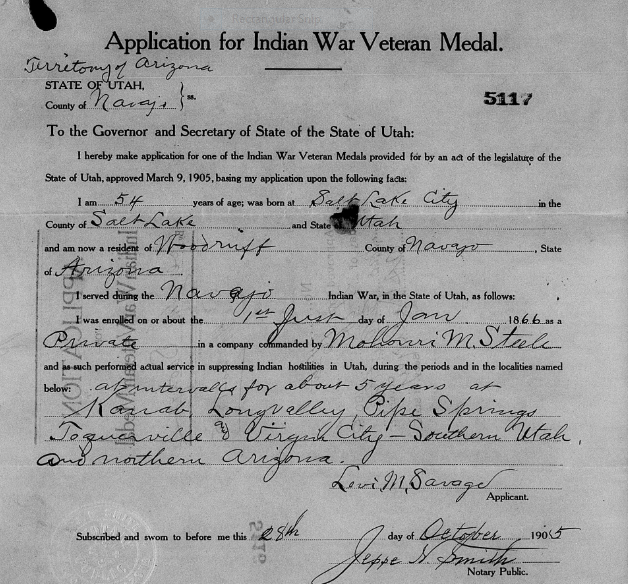
Today I had some time to kill while waiting for a ride so I perused Levi Savage’s Memories and Sources sections. I found that someone had linked (in the Sources section) to his application for a medal for his service in the Indian Wars in Utah Territory 1850-1872 (1).

I learned that he was a private and served under Commander Mahonri Steele. He enlisted January 1, 1866 and served intermittently for about 5 years, according to his application.
c1

He applied in 1905 and received the medal in 1906. He wrote a note allowing someone else to pick it up for him (as he was living in Arizona Territory).

c2

While this doesn’t add anything critically important to understanding Levi’s life, it is one more thread in the tapestry of his life. It shows that he valued recognition. I knew he and his father lost some land due to troubles with the Native Americans (see this post from a series of posts), but I didn’t know there were official companies formed. Definitely something I will look into further.

Footnote:

1: “Utah Applications Indian War Service Medals, 1905-1912,” database with images, FamilySearch (https://familysearch.org/pal:/MM9.1.1/QKDV-MXQQ : 17 March 2018), Levi M Savage, 28 Oct 1905; citing Military Service, 5117, series 2220, State Archives, Utah; FHL microfilm 1,445,896.


1918 flu and the Boston Red Sox

Last night I invited some new friends to dinner. They had just moved to Boston. Wanting to introduce them to several of the cool things in Boston, I served Hood’s Red Sox Green Monster Mint ice cream for dessert. After explaining to them what the Green Monster is (a big wall in the outfield between 2nd and 3rd bases) and who Wally the Mascot is, I mentioned that prior to my moving to Boston, the last time the Red Sox won the World Series was in 1918.

Wait–1918? That was when there was the big flu pandemic. Was there really a World Series that year? Not that public officials were all that quick to react to shutting down public events during the outbreak. A quick Google search revealed that the baseball season was shortened that year due to World War I and the World Series was held September 5-11, at the beginning of the outbreak in Boston.

This Smithsonian article tells what else was going on during the World Series and what it may have looked like. Some things have changed a lot in the last 100 years.


Always read the footnotes

I am very interested in domestic medicine (medicine practiced in the home) and recently began branching out from colonial medicine to 19th century “Mormon Medicine” as all of my 19th century ancestors converted to Mormonism between 1830 and 1880. Understanding the medical techniques practiced among the Mormons would add social context to my research.

I planned a trip to the Church History Library in Salt Lake City in June 2017. I reached out to a librarian prior to coming and she sent me a list of articles to read before we met. The articles focused on faith healing, an important aspect of Mormon medicine.

As a good researcher should, I skimmed the footnotes as I was reading the articles on the plan en route to Salt Lake. Lo and behold, my 2x great grandmother Hannah Adeline Hatch (Addie) was mentioned. I know of the incredible woman that Addie was and that she suffered many health problems throughout her life, but I had no idea that she was a healer or that she left behind a diary which is publicly available.

You can bet I downloaded that diary the first chance I got. I am in the process of transcribing it.

Don’t forget to read the footnotes. You never know what you might find.


Addie

Old North Church and domestic medicine

On Oct 2 I had the opportunity to talk at the Old North Church in Boston (of Paul Revere, one if by land, two if by sea fame) about medicine in the 1600s.  I used medical recipes as the lens to examine common beliefs and treatments in the home in the 17th century, including botanicals, magic, religion and astrology. It is a fun way to introduce the audience to 17th century medicine. C-span filmed the talk so you can watch to learn more.20150711_095931

Hex Marks in New England

I visited the Fairbanks House for the first time today in Dedham, MA. It is the oldest timber frame house in North America, built around 1637.

IMG_3915

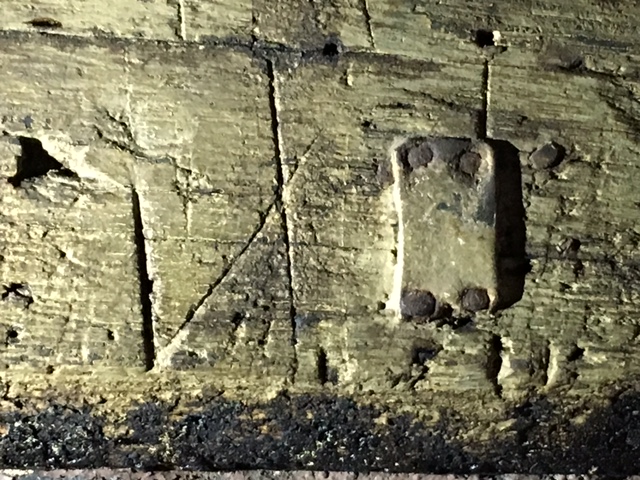
The home was continually inhabited by members of the Fairbanks family until the early 1900s, when it became a museum. We learned about early American architecture, woodwork and Puritans, but the most fascinating part to me was this little mark (the X) near the fireplace:

IMG_3936

Known as a witch mark, or a hex mark, it was a protection against witches in a time when everyone thought that they existed. The chimney was thought to be the easiest access point for witches, so the mark placed here would help keep them from entering the home through the fireplace.

I had heard of these in England, but had no idea any existed in New England. While rare, this house is not the only house in North America with this protection. Shoes were also found hidden near the chimney. According to the curator, foot odor was thought to be the essence of humans. If old, smelly shoes were hidden in the chimney, witches would be distracted and not enter the home.