Fall Social History Events in Greater Boston

With the start of the new school year comes many opportunities to explore social history through the offerings of local history and genealogy societies, living history villages, and repositories.

A great way to meet new people and be exposed to all aspects of genealogy and history, including records you can use in your social history research, is to join a local history or genealogy society. Here is a list of historical societies and genealogy societies in Massachusetts.

The Mass Moments website publishes an article each day on something significant in Massachusetts history that occurred on that day.

The Boston Public Library’s fall local and family history series is on Colonial Research. Two talks per month are scheduled on Wednesday evenings.

The American Antiquarian Society is sponsoring a one-woman show portraying boarding house life in Lowell in 1843. Check out this site for other upcoming events.

The Massachusetts Historical Society sponsors brown bag lunches, speaking events and seminars throughout the year. Most are free and open to the public. They also offer 5 seminars that are free and open to the public over the 2013-14 semesters. If you pay $25 you have access to the reading in advance. More information can be found here. The 5 seminars are: Early American History, Environmental History, Immigration and Urban History, and History of Women and Gender. All are focused on the Boston area.

There are several living history villages in the area that have fall programming. I have always wanted to go to the Harvest Dinner with the Pilgrims at Plimoth. Maybe this will be the year that I will make it down there.
Strawbery Banke in Portsmouth, NH
Old Sturbridge Village in Sturbridge, MA
Historic Deerfield in Deerfield, MA
Plimoth Plantation just outside of Plymouth, MA
Olde Mistic Village in Mystic, CT

Copyright: Do you know the basics?

I was planning on posting about some more of the collections at the Library of Congress. When I was looking through the LOC website deciding what I wanted to write about, one of the first things I came across was their paragraph on who has the rights to their digital images. In most cases, it is not the Library of Congress, and it is the responsibility of the person wanting to use the image (you and me) to assess whether the item is available for public use or is under some sort of copyright or other rights.

This reminded me of several recent conversations on Facebook about copyright for genealogists and how important it is to understand copyright. I am by no means an expert, but I wanted to bring this to your attention. In social history and genealogy, we love documents and photos for blogs, written family histories and other uses. Here are a couple of blogs and a webinar that address copyright for genealogists.

Judy G. Russell is a professional genealogist with a law degree and occasionally writes about copyright on her blog.

The author of this blog is not a genealogist as far as I can tell, but shares her experience about being sued for using a copyrighted picture on her blog. Note that some comments have been made on  Facebook stating that not all of the resources listed in this blog are necessarily free of copyright–you should always check!

Thomas MacEntee will be giving a free, open to the public webinar on Thursday, July 18 at 9 pm EDT on copyright, sponsored by the Utah Genealogical Association. I don’t see this listed on the UGA website,  but you can register for it here.

Google genealogy and copyright for additional resources.

Library of Congress: Digital Newspapers as resources

The Library of Congress’ Chronicling America website has amazing resources available to you for free from the comfort of your home. Several posts will be dedicated to the resources available there, but we’ll start with the digital newspaper collection. About 4 million images of newspapers from around the country from 1836 to 1922 are available on this website free of charge. The search function is fairly easy to use and you can do a basic search or a more advanced search. You can search by name, location or other keywords.

I searched for Levi Savage and the search results looked like this. There are 203 results, with 20 on each page. The digitized page for each result is shown, with Levi’s name highlighted in pink. You can zoom and save as a pdf file to your computer. Many of the newspaper articles dealt with his service in the Mormon Battalion, his son Levi Mathers Savage, and occasionally his father.

Example of search at LOC

Here are a few of the interesting things that I found:

This is when Levi’s trial for cohabitation began.
The Salt Lake Herald, Sept 10, 1887, page 8

The Salt Lake herald September 10 1887 Page 8

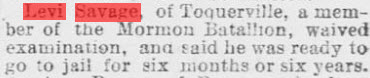
In other records I have found the information needed to track down Levi’s court records. However, they have been lost and are not available. Therefore, this newspaper account of his words at the end of his trial are important to understanding him and the role polygamy played in his life. The Salt Lake Herald September 30 1887 Page 8

The Salt Lake herald September 30 1887 Page 8

This tells me where he was taken so that I can further progress in my research.
Salt Lake Herald Oct 1 1887 page 8

salt lake herald oct 1 1887 page 8

This is a lot of money back then. Definitely something to look further into and figure out what was going on. Based on entries in his son’s journal, I suspect this is for damages sustained in Millard County in the late 1850s or early 1860s. This is where they lived before moving to Toquerville.
The Salt Lake Herald Feb 14 1899 page 6

the salt lake herald feb 14 1899 page 6

Don’t look just for your ancestor’s name. A big part of social history is learning about the bigger world in which your ancestor lived and gaining various perspectives on events in your ancestor’s life. This article is a great example of how to do this. I don’t know that Levi felt this way, but I know that somebody that lived in the same area thought Toquerville was a great place to live.
The Union Sept 18 1897

The Union Sept 18 1897

I used the SnagIt program to pull out just the portion of the page that I wanted. But, in doing your own research, don’t forget to look at some of the articles that are around the article of interest to get a sense of what else was going on. Looking at advertisements can be especially interesting and enlightening.

If interested, here are a few links about Chronicling America
http://edsitement.neh.gov/what-chronicling-america
http://www.neh.gov/divisions/preservation/featured-project/new-release-chronicling-america
http://blog.eogn.com/eastmans_online_genealogy/2013/04/national-digital-newspaper-program.html

What are some of the treasures you have found on the Chronicling America website? I would love to hear from you in the comments section.

Are you going to NERGC?

Are you going to the 2o13 New England Regional Genealogical Consortium Conference, usually referred to as NERGC? The conference is held every other year in New England and is a wonderful place to network with other genealogists and to learn about new records and resources for genealogical research, including incorporating social history into your research.

Here is a sampling of talks related to social history:
Special Schedules of the US Census: Embroidery on Your Family Tapestry
Organizing & Dating your Old Photographs
Oyster River Settlement and the Native Peoples
Photographic Treasures: Bringing Your Research into Focus
Catching Threads: Reading the Genealogy in Homemade Artifacts
Workers Unite: Workplace Clues to Place of Origin
A Rural New Hampshire Barter/Cash System in the Mid-19th Century
Loyalist Migrations: Leaving and Returning to the United States
Like Grandma Used to Make: Researching Ancestral Foodways
Indentured Servants in the New England Colonies
Digging up the Dirt on Your Farmer
Broken Threads: Labor in Rhode Island in the 1920s
An Acadian’s Family Story Through Six Generations Following Deportation
Researching A Community
The Symbolism on New England Gravestones: 17th Century to Present
Polish Traditions, Customs and Superstitions
Creating A Family Tapestry: Writing a Family Narrative
Leaving New England: What One Family’s Arc of Migration Can Teach Us All

Looks like there is something here for everyone (plus so many other classes, workshops and networking opportunities). Which classes are you most interested in attending?

What did our ancestors eat?

Recently I have come across many different resources for cookbooks form various time periods. I have also found some cookbooks on Amazon either free or very cheap. These are wonderful resources to learn more about an important part of daily life of our ancestors: cooking and eating.

For those in the Boston area, the Schlesinger Library (part of the Harvard library system) has a wonderful cookbook collection and is one of the few Harvard libraries open to the public. While I have not had the chance yet to review the collection, I did stop by earlier this week to get a general overview of what was there, and the reference librarian was very helpful. Read this news article or visit the library website to learn more.

Another great resource is the Feeding America site at Michigan State University. The University has more than 10,000 cookbooks in its collection and 76 are available digitally on the website. These are from all different time periods from 1798 to 1922. A pdf file is available for these cookbooks, as well as a transcript. They also provide a glossary and pictures of various cooking implements on the website.

Historical cookbooks can also be found in gifts shops at living history museums, on Amazon (search historical cookbooks), and maybe even in your attic or among family papers. Also look at culinary history books that provide an overview of prevailing views about food and nutrition over various time periods.

I’m browsing through “Martha Washington’s Booke of Cookery and Booke of Sweetmeats”  by Karen Hess and “Northern Hospitality: Cooking by the Book in New England”.  What are you reading? What interesting recipes have you found from a place and time important to you and/or your ancestors?